How to Read Drum Lead Sheet Music Pdf
How To Read Drum Music
Rob Mitzner / Articles / Aug 25
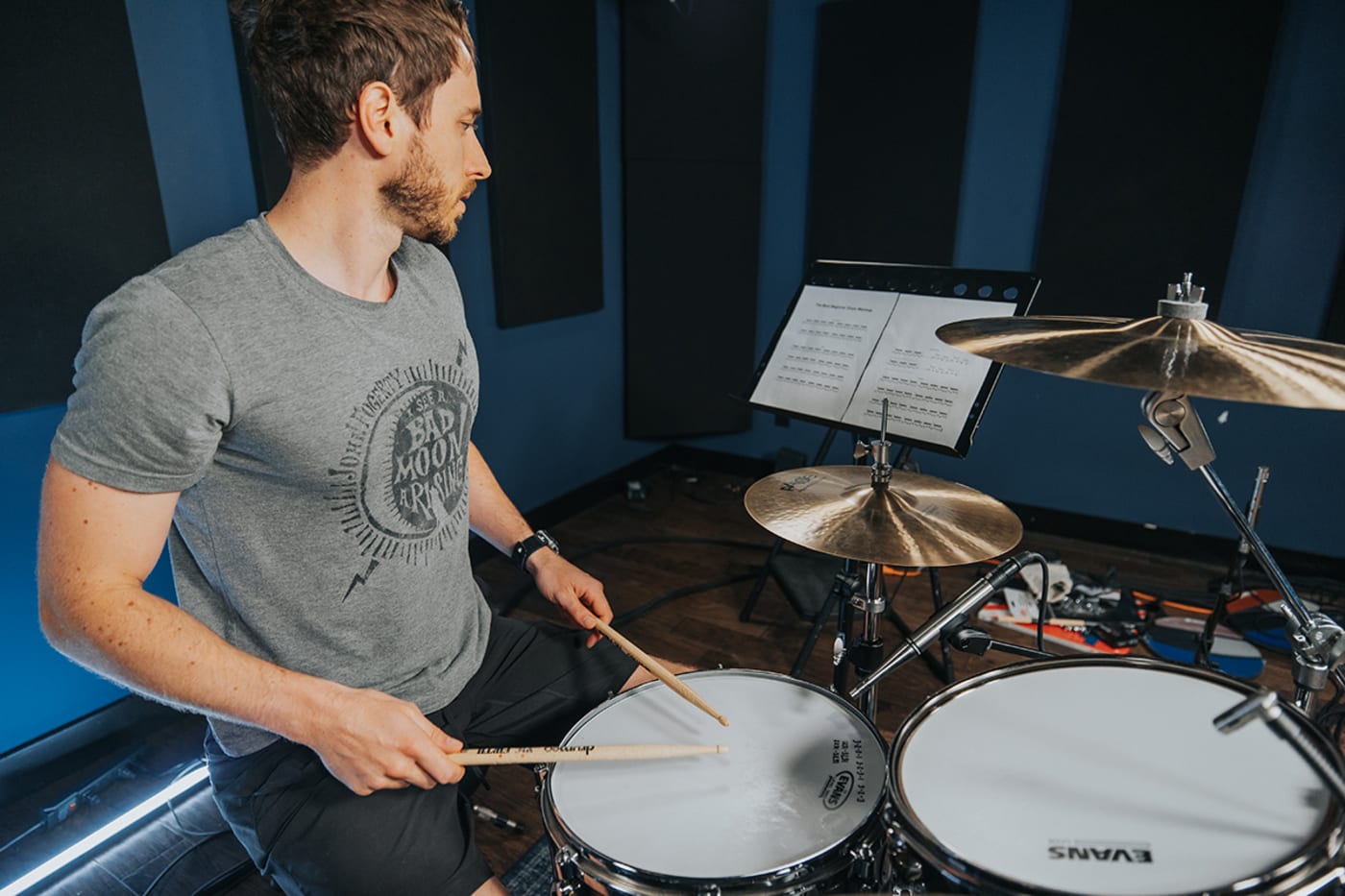
Are you starting to play drums and want to learn how to read music? Peradventure you've been drumming for years but you've been as well intimidated to give it a attempt. Whether it'south a concert score or AC/DC PDFs, this guide will teach you the nuts of reading and writing drum notation from the commencement quarter notation to the final cymbal crash.
This article will teach you several ways to notate drum music and includes multiple formatting styles. Because notation isn't 100% standardized, rhythms may exist presented differently from i pulsate book or lesson to another. It's better to be prepared for anything!
Chapters
- The Staff
- Time Signature & Tempo
- Notes
- Rests
- Sticking, Accents & Phrasing
- Dynamics
- Directions
- Charts
The Staff
Drum note has a lot in mutual with the note for other instruments since it's laid out on a set of five horizontal lines (called a "staff"). Each role of the drum gear up is written on a line – or in the space between the lines – so you can visually tell everything apart.
Lower pitches like the bass drum and floor tom are towards the bottom of the staff, while the snare and toms are in the middle. Higher tones like cymbals are at the peak.
This graphic – known as a 'drum key' – shows where the most common parts of the drum set appear on the staff. Information technology all makes sense when you expect at information technology!

For example, the hi-hat is both at the top (when you lot hit information technology with your stick) and the bottom (when you stride on it).
The two vertical boxes on the left are called the "pulsate clef," which tells us that this music is specifically for drums. Information technology's just like the treble and bass clefs you'll see in notation for melodic instruments.

Time Signature
This is 1 of the first things you should look for when you see a drum chart. The time signature is the two numbers stacked on top of each other on the left side of the staff.
Written music is divided into chunks called measures. Call back of a mensurate (or "bar") every bit a pie. Every measure has a certain number of counts or "beats" in it, which brand up fractions of the whole pie.
In the time signature, the top number tells yous how many beats are in each measure. The bottom number tells you the value of each beat. For example, four/4 time has 4 beats per measure and each crush is worth one quarter annotation. half dozen/8 fourth dimension has 6 beats per mensurate simply each beat is worth one eighth note.
It'south also of import to check out the tempo or "beats per infinitesimal" at the peak left of your nautical chart. A tempo of 60 beats per minute (

Notes
At present that you know the basics of the staff, fourth dimension signature and tempo, it's time to bank check out some pulsate note!
Allow's starting time at the acme. Cymbals and hi-hat notes are unremarkably written equally an 'x' while drums are written as solid round notes.

Here are some of most common note values you'll run across and their value in 4/4 time:


Adding an additional 'slash' to the stalk of a annotation cuts its value in half.

Other types of notes
Dotted notes
Placing a small dot to the right of whatsoever of these notes adds an extra l percentage of the note's value. For example, if a quarter annotation is worth 1 beat, a dotted quarter note is worth 1.5 beats.

Continued groups
Multiple notes that comprise a beat are often connected by horizontal lines called "beams" to make them easier to grouping visually.

Tied notes
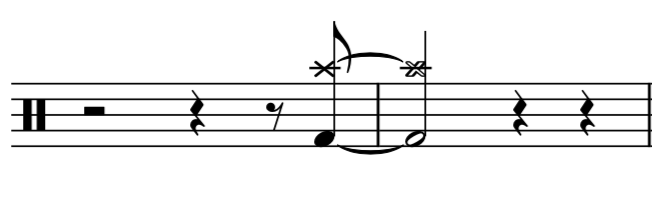
A curved beam or "necktie" connecting ii notes means that you play them as if they are ane annotation. The 2nd note is silent and its value is added to the get-go. For example, if in that location is a cymbal striking on the "and" of crush 4, it is written every bit a tied note across the bar line to show its longer sustain.
Triplets
Triplets are made upward of three notes equally spaced over a period of time where in that location would normally be 2 notes. They're connected by a horizontal beam and written with a small '3' in a higher place them.
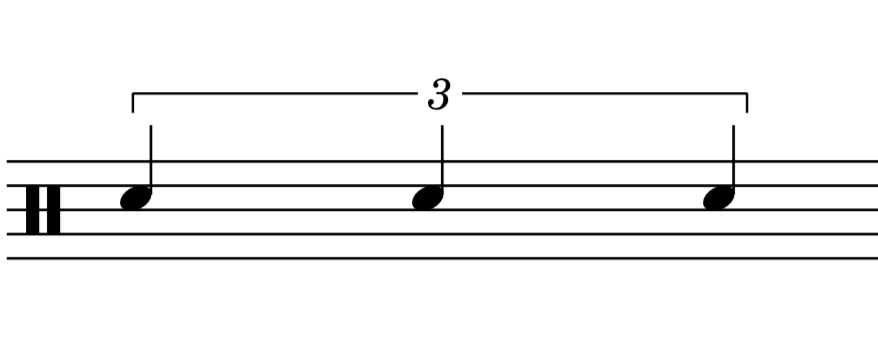
Triplets are the almost common type of "tuplet" (which is any equal subdivision of notes spaced evenly over a larger note length).
Stems
Yous may likewise notice the stems of the notes (the direct vertical lines jutting out). In traditional drum notation, notes played with the feet have downward-facing stems, while everything else points upwards. This shows you the separation of the easily and feet (and isolating your limbs tin help you learn new patterns).
The annotation values of the hands and anxiety each add together up to the total number of the beats in the whole mensurate (for instance, in 4/iv time, the notes and rests in the hands would add upwardly to iv, and so would the notes and rests in the feet).
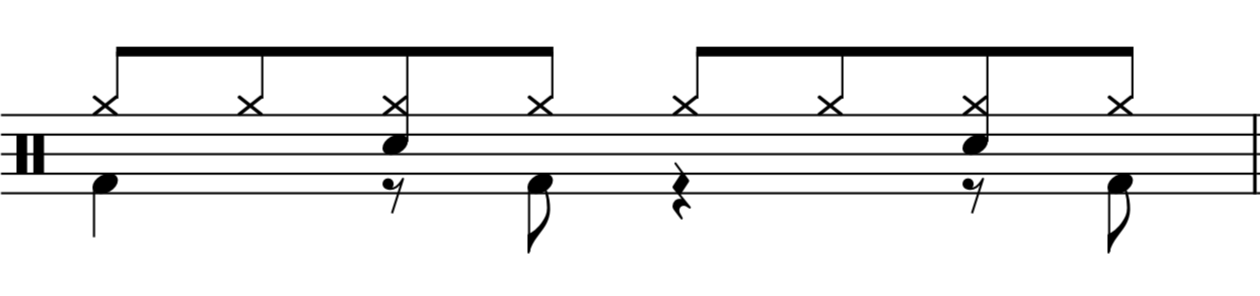
1 thing to proceed in heed about music notation is that there are a lot of small-scale variations in the way different people write things. Many of the rules are flexible and evolve over time. In modern pulsate note, all the stems point upward (even the notes played on the bass pulsate) and everything looks more continued. All the notes together add up to the total number of beats in each measure out.
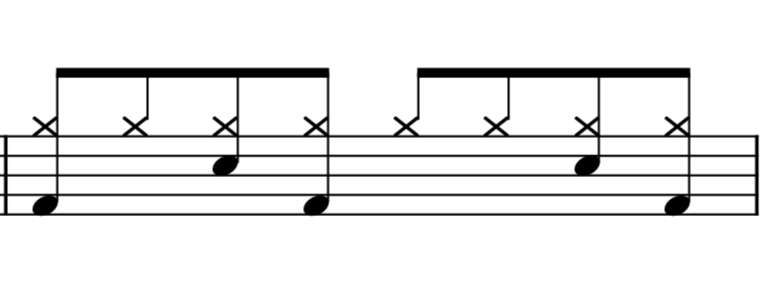
Nonetheless, it's harder to visualize the separation of the easily and feet this way. Traditional and modern annotation both have pros and cons, and information technology's useful to learn how to read both styles.
Rests
A rest tells you lot when non to play. Here are some of the most mutual types in iv/iv fourth dimension.


Only like with notes, adding a dot tacks on an additional fifty percent of the rest's value. For instance, hither's a dotted quarter-note rest (worth i.5 beats):

Sticking, phrasing & accents
Now that you've got a bones idea of how notes and rests work, permit's get into some other important symbols you might come across in different types of pulsate music.
Sticking
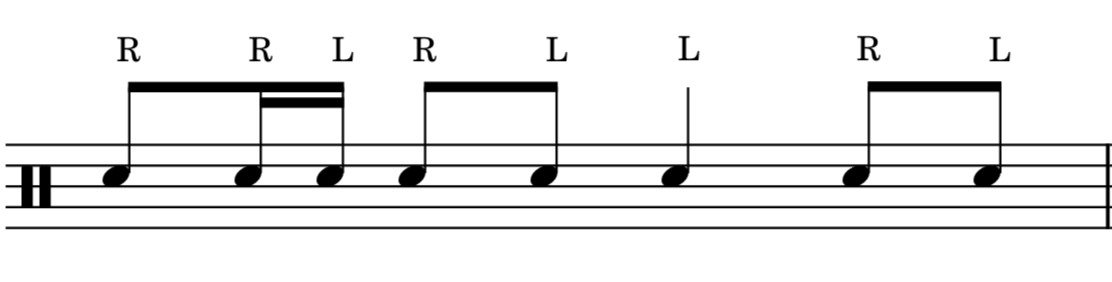
If y'all run across the messages 'R' and 'Fifty' in a higher place or beneath the staff, these signify which notes should be played by your right and left hands. This pops up most commonly in educational exercises and rudiments rather than full song charts.
Accents & articulation
Accented notes should be played louder than the rest. The most mutual type of accent symbol is a wedge with the opening pointing left. Hand accents are normally written above the staff, while pes accents are beneath. Less common is a wedge with the opening pointed downward, which ways the emphasis should be a short or "staccato" notation.

Phrasing markers
These are super helpful in telling us how a note should be played. Staccato notes have a dot to a higher place them (it'southward commonly all-time to play those on a drum rather than a cymbal that rings too much).
Longer, or "legato" notes tend to exist tied to visually indicate their duration. These piece of work best if you play them on cymbals since they accept more sustain.

Open/closed hi-hats
When you run across an 'o' sign above the hi-hat, that ways y'all should elevator your toes and open it. A plus sign means you should shut the hats.
Sometimes people use curved beams to connect open and closed how-do-you-do-hat notes (but sometimes they don't…and so be ready for either fashion!)

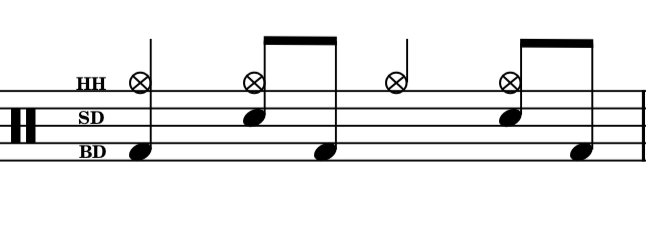
Loose hi-lid notes (where yous should play the hello-hat partially open) are frequently written equally an 'x' with a circle around them.
Grace notes (flams & drags)
Notating and reading rudiments is an important office of understanding drum music. Flams and drags are types of "grace notes" which have no numerical value – y'all just play them immediately before another annotation.
"And so I don't count them as part of my pie when I add together all the notes and rests in each measure?" Nope!
Call back of these as fiddling ornamentations that precede the main note they're attached to. They're tied to the master note with an upward-facing curved beam.

Buzzed notes & rolls
Bounced notes are written with a slash through the stem of the note. This is called a "tremolo". One slash indicates a bounciness or double stroke, and these slashes are also used to notate open rolls (where y'all can hear each stroke individually).
Closed rolls and buzzes (where you tin't hear each individual annotation) have a 'z' through the notation'due south stem.
Longer rolls of either type are written equally tied notes to indicate their length. They'll also sometimes have a number written next to the tie to tell you how many strokes are in the coil.

Breaths & pauses
Along with the rests nosotros went over before, here are a few other signs you lot might run into in drum music.
A caesura (commonly chosen "railroad tracks") is a pause marker with two leaning vertical slashes. Information technology basically means "stop right at that place!"
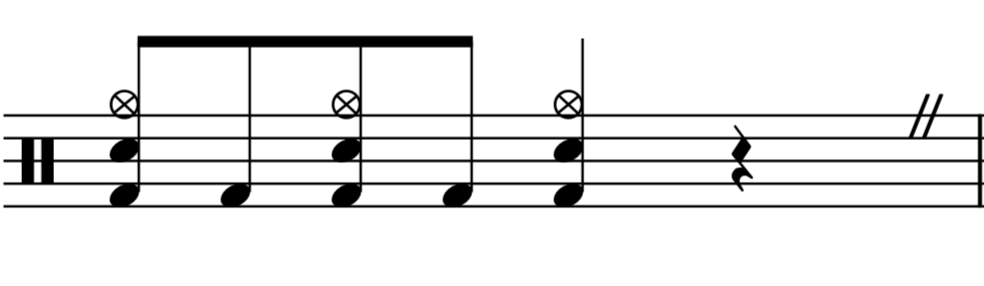
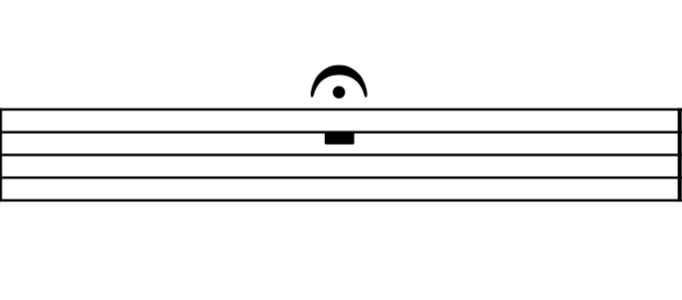
A fermata, or "hold" is written as a downward facing semi-circle with a dot in the centre. This indicates a total intermission in the music where you stop counting the time.
You may also see a pair of eyeglasses, which is an informal way to say "sentry out, here comes something of import!"

Percussion & other variations
Cowbells, wood blocks, and triangles are written with triangular or diamond-shaped note-heads on different lines of the staff.
Cantankerous-sticks are written with an '10' on the snare pulsate line, while other types of rimshots (striking the rim and snare together or hitting one stick with the other as it rests on the snare head) announced every bit a round note with a slash through it.

Stay warning and be gear up for unlike types of notation!

Dynamics
Dynamic markings are some of the almost important symbols on any drum chart. They help you lot play with sensitivity and convey important changes in the music. If you nail the dynamics on drums, anybody in the ring volition beloved you!
Here are a few of the near common dynamic markings from quietest to loudest:
ppp (triple pianississimo, sometimes called "triple-p" or "triple piano") – This means "very, very quiet." As quiet as you lot can play!
pp (pianissimo, or "double-p") – This means "very quiet," or just barely to a higher place ppp.
p (piano) – Quiet
mp (mezzo-piano) – Medium or moderately quiet
mf (mezzo-forte) – Medium or moderately loud, merely not besides loud
f (forte) – Loud
ff (fortissimo) – Very loud. We're non quite at top book, but nosotros're close!
fff (fortississimo) – Very, very, loud. This is sometimes also called "triple-forte" or "triple-f." Now nosotros're in ear-spitting territory!
Along with these basic dynamic markings that tell you how loud or quiet to play, there are also a couple of important symbols that betoken changes in the dynamics.
A crescendo is a gradual increase in the volume notated with a right- facing "hairpin." Make sure non to get too loud right away and let the volume to build steadily.
A decrescendo (or diminuendo) is the opposite. Once again, brand sure not to get to your final book too quickly. Keep an eye on the duration of the dynamic change and bring your volume downwards steadily. These subtle dynamic changes can make a large deviation in your audio!

Along with these basics, here are a couple of other dynamic symbols that are important for drummers.
If you run into the word subito (or "suddenly," sometimes abbreviated "sub.") before a dynamic marking, that ways you're making an abrupt change. For instance, if y'all've been chugging along at 'mf' or 'f' and you see "sub. p," bring the volume down right away.

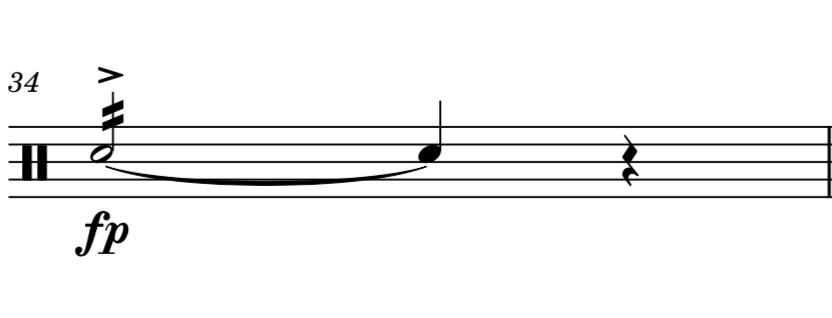
Another similar concept uses an 'fp,' or fortepiano sign. This is a loud first note followed by an immediate drop in book. You'll frequently encounter these on the commencement note of a dramatic coil (call up of a archetype pulsate roll used to build tension and play vaudeville artists onstage).
Besides keep an centre out for the 'sfz', or sforzando symbol, which literally means "suddenly, with forcefulness." The idea here is to emphasize the attack of a note or phrase (smack it, then go back to whatever dynamic level you lot were at earlier).

Directions
Knowing how to read the road map is the central to a successful journey through whatever drum chart. Here are a few of the most common directional signs you'll come up across:
Repeats
There's a lot of repetition in pulsate music, so you might see these a lot. A repeat is written as 2 vertical bar lines with two adjacent dots which signal that y'all should go back and play a department again.
"But where do I go back to?" Just await out for the inverted repeat sign to tell you the purlieus of the repeated section. If there'due south no inverted repeat signal, go back to the beginning of the chart. Repeat the section once unless otherwise indicated.

First & second endings
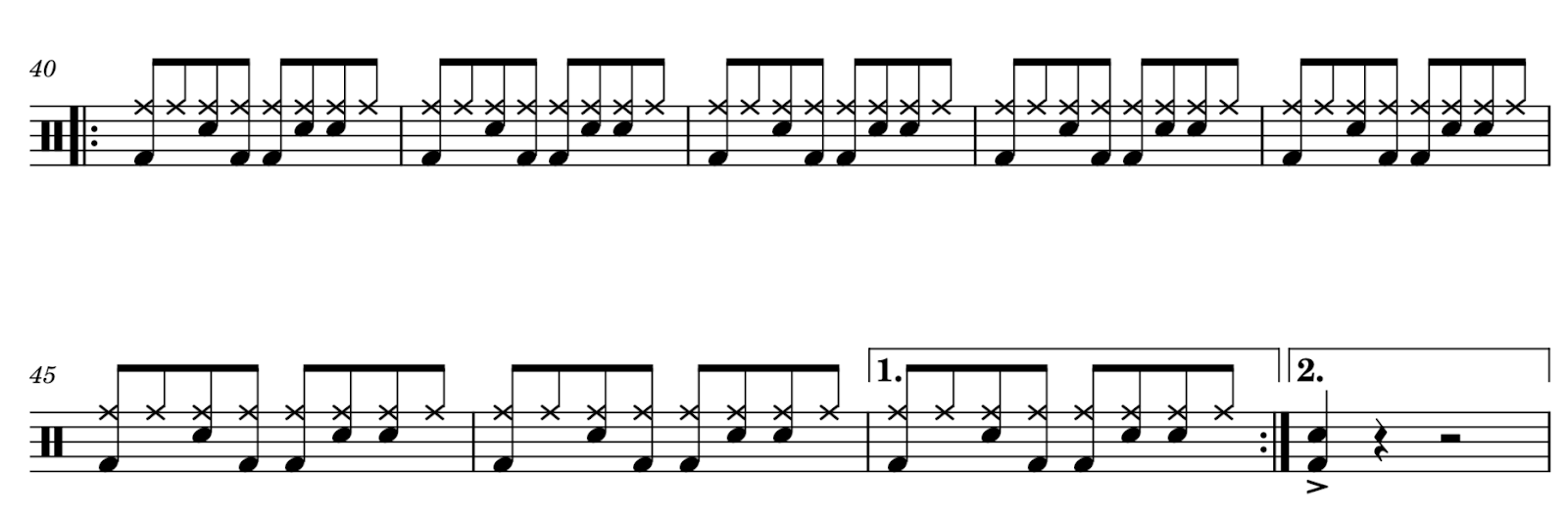
Sometimes a section of your chart volition echo, but the final bar or ii is slightly different each time. First and second ending markers brand the whole thing easier to read by notating these varied endings without rewriting the entire section (so you lot'll ultimately have a shorter chart with fewer page turns).
The first time through, play the showtime ending (the measure out with the "i" over it) and leap back to the inverted repeat sign. After you get through the 2d time, skip the get-go catastrophe and jump directly to the second before you go along.
Some charts have even more than two endings, and then just keep repeating until you lot get to the last one.
Codas
This is another way to shorten the length of a nautical chart by jumping astern and frontward so you don't take to re-write a section that repeats. This concept tin can be tricky at kickoff, only once you lot become it you'll be in great shape to read any kind of drum nautical chart.
The first thing you lot'll need to look out for is the 'D.S.' or Dal Segno, which ways "from the sign."

Recollect of this as a portal back to an earlier symbol in the chart (commonly called "the sign"). Information technology looks like an 'Southward' with a astern slash through it and two dots on either side.

A 'D.C'., or Dal Capo is a similar concept that ways "get back to the get-go" instead of to the sign. Either fashion, you're jumping backward to an before signal in the chart.
Ordinarily, the D.S. or D.C. marker will have the words "al Coda" or "al Fine" afterwards it. This tells us whether to play straight through to the finish ("al fine") or if we've got one more jump to make ("al coda"). If information technology'south an "al coda," go along playing until yous run into a "To Coda" marker.
The Coda, which looks like a bullseye (or a circumvolve with a plus sign in it), is our ultimate destination and the "To Coda" marker is another portal that sends united states of america frontwards to become there (it'southward like warping in a video game). Afterwards you lot leap forwards to the Coda, play through to the end and collect your prize.

Measure repeats & slash marks
These popular upwards a lot in drum charts. Full measure out repeats are written as a backward slash with 2 dots and bespeak that yous should play whatever you played in the previous bar. Multi-measure repeats will accept 2 slashes and the number of confined written above this symbol.

Many drum charts also utilise a concept chosen slash notation to indicate that the drummer should play time or continue grooving. This concept features crooked hash-marks on each shell of the mensurate instead of writing musical notation or patterns.
Compared to measure repeats, slash marks offering a bit more flexibility to vary the pattern you lot're playing.

Mensurate numbers & rehearsal letters
Measure numbers are landmarks that tell yous how many measures into the piece you are.
Rehearsal letters unremarkably correspond with unlike sections of the song. The poetry could be "Letter A," the chorus "Alphabetic character B," etc.
Both of these types of markers are especially useful when y'all're rehearsing longer pieces of music and usually announced to the left of the staff.

Charts
Along with traditional notation, drummers should be able to read and write other types of charts. Every musical state of affairs is unlike and sometimes one of these other types fits the bill.
This video shows how drum charts assistance you lot learn songs faster:
Pb sheets
These include the major landmarks of the vocal (similar melody, dynamics, class and accents), and anybody in the band oftentimes reads the aforementioned ane. These charts won't have the verbal drum design written out for you, so the pull a fast one on is to interpret the information and come with the right groove, fills and other details.


The more you encounter these charts, the better you lot'll get at using your ear and intuition to fill in the blanks.
Road maps
These are "drummer shorthand" charts you can create if you lot're learning a song by ear. Route maps give y'all the information you need to get through the song before you've completely memorized it.
They should contain the number of measures in each section, notes on the dynamics, fills and hits, and any other information that could be helpful in playing the melody.

For a detailed run-down on how to create road maps, bank check out this article.
Drum tablature
Drum tabs are some other type of autograph that tin can help you larn patterns if y'all don't know how to read music. This manner of notation is more than commonly used past guitar players, but it'southward good to know how it works.
Each piece of the pulsate is symbolized in abbreviated mode on a horizontal line while different letters indicate various ways to strike them. Instead of rests, the spaces between the notes are indicated with dashes.
Here are some of the most common symbols:
x – Cymbal or howdy-chapeau
X – Absolute cymbal
o – Normal hit on a drum or open howdy-hat
O – An accented note on a drum
g – A quieter notation
f – " data-gt-translate-attributes="[{"attribute":"data-cmtooltip", "format":"html"}]">Flam
d – A bounced note or elevate
b – Ride cymbal bell
@ – Snare rim

The bottom line
Drum notation has many similarities to the music written for other instruments, merely at that place are also a ton of important differences. Whether you're a beginner or an experienced player, knowing how to recognize and interpret the notes, rests, dynamics and directions in a pulsate chart volition help you get a ameliorate player and a stronger overall musician.

Rob Mitzner is a New York-based session drummer who has recorded for Billboard Meridian-10 charting albums, films and Broadway shows, performing live at Lincoln Center, The Smithsonian, Caesar'southward Palace, The Blue Note, Boston Symphony Hall and for President Obama in his hometown of Washington D.C. He is currently working on a drum volume with Hudson Music and has also been featured in Downbeat Mag and Mod Drummer, and on the national TV show "Trending Today" on Vice. Rob holds a B.A. in Music and Political Science from Brown University, and is a proud endorser of Paiste Cymbals, Remo drum heads, Hendrix Drums, and Drumdots.
Source: https://www.drumeo.com/beat/how-to-read-drum-music/
Belum ada Komentar untuk "How to Read Drum Lead Sheet Music Pdf"
Posting Komentar